Table of Contents
- Summary
- Introduction
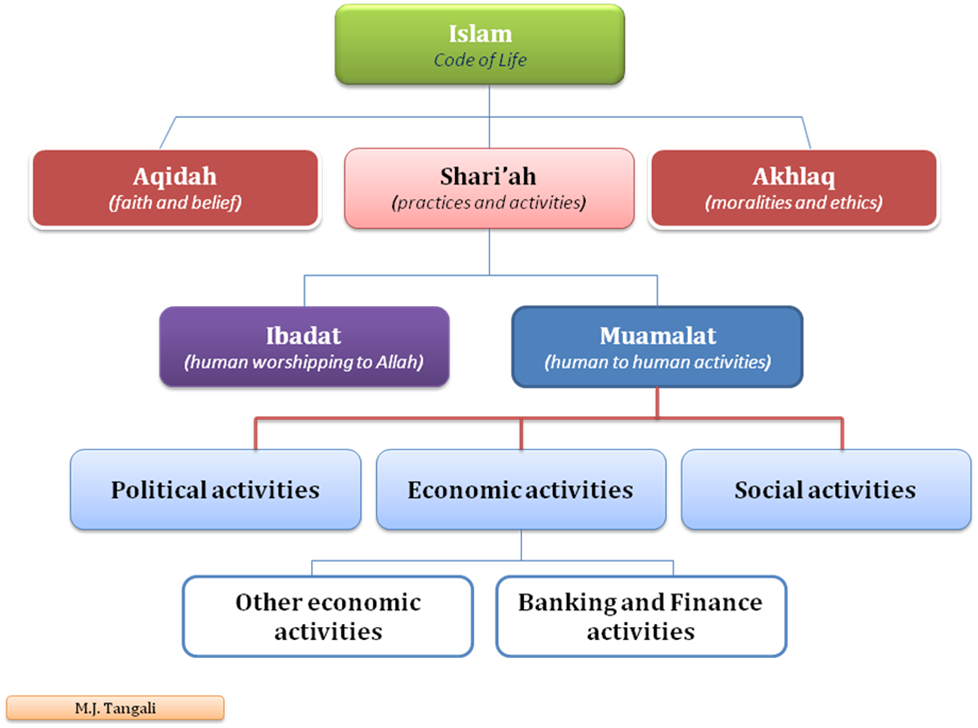
- What is Islam?
- Faith
- Sources
- The Holy Qur’ān
- The Legal Classification of Ḥadīth
- Schools of Thought
- Uṣūl al‑Fiqh
- Sharīʿah and English & Dutch Courts
- Conclusion
Summary
Islam is a vast and profound religion, and it remains the fastest‑growing faith in the world. It is the only religion accepted by Allāh Almighty, and those who follow other religions or beliefs will be among the losers at the end of time. Islam is the foundation of life, as the Holy Prophet Muhammad ﷺ taught us.
This wisdom has been preserved for more than 1,400 years in the Holy Qur’ān and the Sunnah. From these sources, all branches of secular sciences have originated, including laws, regulations, and jurisprudence. Justice is the supreme purpose and guiding spirit of the Sharīʿah. It provides the framework for the entire corpus of Islam, shaping and molding its beautiful configurations.
The paramount mission for which the Prophets were sent, and for which they struggled throughout their lives, was to guide humanity toward achieving justice.
Introduction
In this part, an introduction to the Sīrah of the Holy Prophet ﷺ is outlined. It provides deeper insight into Islam as a religion, the treasures of Islam, and the Islamic legal system. These themes are supported by verses from the Holy Qur’ān and Ḥadīth.
The Last Messenger ﷺ
After the ascension of Prophet ʿĪsā (ʿalayhis al‑salām) to the heavens alive, the world was covered with a dark veil. People returned to gambling, adultery, drinking alcohol, and idol worship (Ibn Kathīr, n.d.). At that time, the world was enlightened by the birth of the last Prophet and Messenger of Allāh Almighty (22 April 571 CE / 12 Rabīʿ al‑Awwal, 53 years before Hijrah) (Al‑Ṭabarī, 1987). The awaited Messenger had finally come. It was a joyous spring; happiness was seen both on earth and in heaven (Ibn Isḥāq, 1955).
The good news of his birth was conveyed to ʿAbd al‑Muṭṭalib, the Prophet’s grandfather. He hurried to the house of ʿAbdullāh and was delighted when he saw the heavenly child. Never had he seen such a beautiful and radiant face. He took the child in his arms to the Kaʿbah for tawāf and then returned him to his mother, Bibi Āmina (Al‑Suyūṭī, n.d.).
When the child was one week old, ʿAbd al‑Muṭṭalib hosted a feast for the Quraysh tribe. When asked about the child’s name, he replied: “I named him Muhammad (the Praised).” The Quraysh questioned why he chose such an unusual name, as no one in his family had borne it before. He answered joyfully: “My grandson is not like other children. I want the earth and the sky to be filled with his praise.” Thus, the child was given two names: Ahmad, as revealed by the angel Jibrāʾīl, and Muhammad, as chosen by his grandfather. Both names were prophetic, signifying his role as the greatest benefactor of humankind (Guillaume, 1955).
Qur’ānic Guidance
Allāh reveals in the Qur’ān:
وَمَا أَرْسَلْنَاكَ إِلَّا رَحْمَةً لِّلْعَالَمِينَ
“And We sent you not, except as a mercy for all worlds.” (Al‑Qur’ān, 21:107). Al‑Qurṭubī (n.d.) explains that ʿĀlamīn here refers not only to humankind but also to the jinn and all of creation.
Childhood and Foster Care
As a child, the Prophet ﷺ was entrusted to a nurse, Dāʾī Halīmah Saʿdiyyah (raḍiyAllāhu ʿanhā), following Arabian custom. Before this, Bibi Āmina, Hazrat Suwayda, and Hazrat Umm Ayman (raḍiyAllāhu ʿanhum) suckled him. Halīmah reported that when she brought the Prophet ﷺ home, her house was illuminated by his Nūr (light), and she no longer needed lamps at night. She also recalled that his first words were: “Allāhu Akbar, Allāhu Akbar, Alhamdulillāh Rabb al‑ʿĀlamīn.” Halīmah further narrated that at night she would hear him recite: “Lā ilāha illAllāh, Quddūs, Quddūs, nāmat al‑ʿuyūn, wa al‑Raḥmān, lā taʾkhudhuhu sinatun wa lā nawm.”
This phrase blends dhikr (remembrance of Allāh) with Qur’ānic reference:
- Lā ilāha illAllāh: The shahādah, core of Islamic belief.
- Quddūs, Quddūs: Emphasizing Allāhs absolute purity.
- Nāmat al‑ʿuyūn: The stillness of night.
- wa al‑Raḥmān: Highlighting Allāhs mercy.
- lā taʾkhudhuhu sinatun wa lā nawm: From Āyat al‑Kursī (Al‑Qur’ān, 2:255), affirming Allāhs perfect vigilance.
Early Signs of Prophethood
Halīmah’s sons, who herded sheep, noticed extraordinary events. Stones greeted the Prophet ﷺ with “Peace be upon you, O Prophet of Allāh.” Trees and bushes bowed before him. These signs confirmed his uniqueness.
One day, two angels clothed in white descended, opened his chest, and purified his heart. Ibn Kathīr (n.d.) comments on the verse:
أَلَمْ نَشْرَحْ لَكَ صَدْرَكَ
“Have We not opened your breast for you?” (Al‑Qur’ān, 94:1). He explains: “We illuminated it, and made it spacious, vast, and wide.”
The Early Life and Mission of the Holy Prophet ﷺ
In that age, Arabia had no schools. Therefore, the Holy Prophet ﷺ did not attend any formal institution. However, he possessed a sharp eye and a remarkable memory. He learned from everything he saw and heard—whether in the desert wilderness or the bustling marketplace (Ibn Isḥāq, 1955). His mind was always fixed on the fundamentals of life and nature. He often reflected deeply: “Why do day and night follow one another? How is it that the cycle of the sun and moon never ends? What service do the wind, clouds, and rain provide to humanity?”
The Prophet ﷺ observed the corruption around him: idol worship, gambling, alcohol consumption, and the burying of daughters alive (Al‑Ṭabarī, 1987). Slaves were mistreated, wives were disrespected, and these injustices continued from generation to generation. He never participated in such practices. Calm and thoughtful, he grew increasingly concerned about the evil he witnessed and sought a way to redeem humanity.
For his livelihood, he worked as a merchant. Yet, over time, his interest in trade diminished as he devoted more attention to spiritual reflection. He often retreated to Mount Ḥirāʾ, a few kilometers from Mecca, where he spent hours—and sometimes days—in contemplation. During the month of Ramaḍān, he would remain in the cave, reflecting on the mysteries of life and seeking guidance for a society in moral decline (Ibn Kathīr, n.d.).
One night in Ramaḍān (610 CE), the archangel Jibrāʾīl (ʿalayhis al‑salām) appeared to him, bringing the first revelation:
اقْرَأْ بِاسْمِ رَبِّكَ الَّذِي خَلَقَ
“Read in the name of your Lord who created.” (Al‑Qur’ān, 96:1). This marked his appointment as the Messenger of Allāh, entrusted to guide humanity to the Straight Path and rid the world of evil.
The Call to Prophethood
Initially, the Prophet ﷺ shared Islam privately with close friends and relatives. Soon after, he received the command:
يَا أَيُّهَا الْمُدَّثِّرُ • قُمْ فَأَنذِرْ
“O you who are wrapped up [in garments], arise and warn.” (Al‑Qur’ān, 74:1–2)
Ibn Kathīr (n.d.) explains in his Tafsīr that the Prophet ﷺ, upon hearing a voice from the sky, saw the same angel who had appeared at Ḥirāʾ. Overcome with fear, he returned to his family and asked to be wrapped up. Then Allāh revealed: “O you wrapped up! Arise and warn.” (Al‑Qur’ān, 74:1–2). Al‑Bukhārī (n.d.) records this narration, noting that revelation thereafter came strongly and frequently.
The Hijrah
As opposition intensified, the Prophet ﷺ and his followers endured severe hardship. In 622 CE, Allāh commanded them to migrate from Mecca to Medina, a journey of approximately 420 km. This migration (Hijrah) marks the beginning of the Islamic calendar.
Companions and Leadership
Among his closest companions were Sayyidunā Abū Bakr al‑Ṣiddīq, Sayyidunā ʿUmar al‑Farūq, Sayyidunā ʿUthmān al‑Ghanī, and Sayyidunā ʿAlī (raḍiyAllāhu ʿanhum). These four are known as the Khulafāʾ al‑Rāshidūn (Rightly Guided Caliphs). Together, they ruled the Islamic state for about 29 years, faithfully implementing the Qur’ān and the commands of the Prophet ﷺ (Ibn Kathīr, n.d.).
Final Days
At the age of 63, the Prophet ﷺ fell ill with a high fever and severe headache. Despite his illness, he continued his mission. On the fifth day, he visited Mount Uḥud to pray for the martyrs buried there. Addressing the people, he warned them against worldly rivalry, fearing it would lead them astray (Al‑Suyūṭī, n.d.).
As his illness worsened, he was unable to lead prayers. He appointed Abū Bakr al‑Ṣiddīq (raḍiyAllāhu ʿanhu), his closest companion and father‑in‑law, to lead the congregation in his place (Al‑Bukhārī, n.d.).
The Passing of the Holy Prophet ﷺ
The Holy Prophet ﷺ, the illustrious Ḥabīb of Allāh, the Mercy unto the Worlds, passed from this world on Monday, the 12th of Rabīʿ al‑Awwal, 11 Hijrah (June 632 CE), at midday, in the home of Bibi ʿĀishah (raḍiyAllāhu ʿanhā) (Ibn Saʿd, n.d.; Al‑Ṭabarī, 1987).
The Janāzah Ṣalāh of RasūlAllāh ﷺ
Explaining the Janāzah Ṣalāh of the Prophet ﷺ in detail, Imām Ahmad Raza Khan (raḍiyAllāhu ʿanhu) states in Fatāwā‑e‑Razviyya: “The ʿUlamāʾ have differences on the issue of the Janāzah Ṣalāh of the Prophet ﷺ. One Jamāʿah says that the Janāzah Ṣalāh did not formally occur. Small groups entered, sent Durūd and Salām, and then departed, followed by others. Certain ḥadīth also indicate this.” (Ahmad Raza Khan, 2009).
Various ʿUlamāʾ accept this Ṣalāh as maʿrūf. Imām Qāḍī ʿIyāḍ rectified this. Hazrat Abū Bakr al‑Ṣiddīq (raḍiyAllāhu ʿanhu) was occupied with consoling the Muslims and attending to the needs of the Ummah. At that time, allegiance had not yet been taken upon his hands. People came in large and small groups and continued to pray the Janāzah Ṣalāh of RasūlAllāh ﷺ.
When allegiance was finally taken upon the hands of Hazrat Abū Bakr al‑Ṣiddīq (raḍiyAllāhu ʿanhu), and his guardianship was confirmed, he prayed the Janāzah Ṣalāh. After him, none other prayed, as mentioned by Imām Shams al‑ʿUlamāʾ al‑Sarakhsī (Al‑Sarakhsī, n.d.).
It is narrated in the works of al‑Bazzāz, al‑Ḥākim, Ibn Saʿd, Ibn Manīʿ, al‑Baihāqi, al‑Ṭabarānī, and al‑Muʿjam al‑Awsat on the authority of Hazrat ʿAbdullāh ibn Masʿūd (raḍiyAllāhu ʿanhu) that the Prophet ﷺ said: “After giving me ghusl and kafan, leave me upon the bier and go outside. Jibrāʾīl (ʿalayhis al‑salām) will first read Ṣalāh over me, followed by Mīkāʾīl (ʿalayhis al‑salām), then Isrāfīl (ʿalayhis al‑salām), and finally the Angel of Death with his entire army. You should then come to me in groups and recite Durūd and Salām.” (Fatāwā‑e‑Razviyya, vol. 4, p. 54; new edition vol. 9, p. 286)
Blessings for Visiting the Prophet ﷺ
It is unanimously accepted that visiting the Rauza‑e‑Anwar (Blessed Grave) of the Prophet ﷺ is a great blessing and honor. Among the narrations, the Prophet ﷺ said: “My intercession becomes obligatory upon him who visits my grave.” (al‑Baihāqi, n.d.)
What is Islam?
As opposition intensified, the Prophet ﷺ and his followers endured severe hardship. In 622 CE, Allāh commanded them to migrate from Mecca to Medina, a journey of approximately 420 km. This migration (Hijrah) marks the beginning of the Islamic calendar (Ibn Isḥāq, 1955; Al‑Ṭabarī, 1987).
Qur’ānic Guidance
Allāh reveals guidance through the Qur’ān:
إِنَّ ٱلدِّينَ عِندَ ٱللَّهِ ٱلإِسْلَامُ وَمَا ٱخْتَلَفَ ٱلَّذِينَ أُوتُواْ ٱلْكِتَابَ إِلَّا مِن بَعْدِ مَا جَآءَهُمُ ٱلْعِلْمُ بَغْيًا بَيْنَهُمْ وَمَن يَكْفُرْ بِآيَاتِ ٱللَّهِ فَإِنَّ ٱللَّهَ سَرِيعُ ٱلْحِسَابِ
“Verily, the religion before Allāh is Islam. The People of the Book did not dissent except after knowledge had come to them, out of envy among themselves. And whosoever denies the signs of Allāh, then surely Allāh is swift in reckoning.” (Al‑Qur’ān, 3:19)
Islam is not a new religion, but the same truth revealed by Allāh Almighty through His Prophets, from Adam (ʿalayhis al‑salām) until Prophet Muhammad ﷺ. For one‑fifth of the world’s population, Islam is both a religion and a civilization full of inspiration. Muslims follow a religion of peace, mercy, and forgiveness. Islam has no connection to the evil events of the world, though Muslims are often wrongly associated with them through media portrayals.
Allāh further reveals:
وَمَن يَبْتَغِ غَيْرَ ٱلإِسْلَامِ دِينًا فَلَن يُقْبَلَ مِنْهُ وَهُوَ فِي ٱلْآخِرَةِ مِنَ ٱلْخَاسِرِينَ
“And whosoever desires a religion other than Islam, it shall never be accepted from him, and in the Hereafter, he shall be among the losers.” (Al‑Qur’ān, 3:85)
Ibn Kathīr (n.d.) explains in his Tafsīr: “Truly, the religion with Allāh is Islam. Allāh states that no religion is accepted with Him from any person except Islam. Islam includes obeying all the Messengers until Muhammad ﷺ, who finalized their mission, closing all paths to Allāh except through him.”
Why Islam May Seem Strange
Islam may appear exotic or even extreme in today’s world. This is because many non‑Muslims do not practice their beliefs daily, while Muslims place Islam primarily, shaping their lives beautifully. They believe and accept that the Sharīʿah (Divine Law) must be taken seriously, making religious issues central to life. Islam is not merely a belief system—it is a complete way of life.
Brotherhood in Islam
All Muslims are brothers to one another, as Islam teaches. This principle was tested in Medina when refugees (Muhājirūn) from Mecca arrived with no homes or wealth. Many had been wealthy before, but Meccan leaders had stripped them of their possessions. The Prophet ﷺ provided a solution: he paired each Muhājir with an Anṣārī (citizen of Medina), declaring, “Now you two are brothers of each other.”
Immediately, the relationship between them became as strong as blood ties. The Anṣārī shared half of his property—home, land, and wealth—with his new brother. Never had the world witnessed such a nation built on solidarity and love.
The Muslim Īmān (Faith)
The Muslim Īmān (faith) is to believe in the Unity, Uniqueness, and Incomparability of Allāh; in the angels He created; in the Prophets through whom His Waḥy (revelations) were brought to humankind; in the Day of Judgment and individual accountability for human actions; in Allāhs full command over human destiny; and in life after death (Al‑Qur’ān, 2:285; Al‑Qur’ān, 4:136).
This is expressed in the Īmān‑e‑Mufassal: Āmantu billāhi wa malāʾikatihi wa kutubihi wa rusūlihi wa al‑yawm al‑ākhir wa al‑qadari khayrihi wa sharrihi min Allāh Taʿālā wa al‑baʿthi baʿda al‑mawt. This declaration outlines the six pillars of faith (arkān al‑Īmān) in Islam:
- Āmantu biʾLlāh – I believe in Allāh.
- wa malāʾikatihi – and His angels.
- wa kutubihi – and His Books.
- wa rusūlihi – and His Messengers.
- wa al‑yawm al‑ākhir – and the Last Day.
- wa al‑qadari khayrihi wa sharrihi min Allāh Taʿālā – and in divine destiny, its good and its evil, from Allāh the Exalted.
- wa al‑baʿthi baʿda al‑mawt – and in resurrection after death.
This creed is a concise summary of what every Muslim is expected to believe. It is often memorized and recited as part of foundational Islamic education and spiritual reflection (Ibn Kathīr, n.d.; Al‑Ṭaḥāwī, n.d.).
Belief in and the Chain of the Prophets
Muslims believe in a chain of Prophets beginning with Adam (ʿalayhis al‑salām), including Nūḥ (Noah), Ibrāhīm (Abraham), Ismāʿīl (Ishmael), Isḥāq (Isaac), Yaʿqūb (Jacob), Yūsuf (Joseph), Ayyūb (Job), Mūsā (Moses), Hārūn (Aaron), Dāwūd (David), Sulaymān (Solomon), ʿĪsā (Jesus), and Ilyās (Elias) (ʿalayhim al‑salām) (Al‑Qur’ān, 6:84–86).
Allāhs final message to humanity—a reconfirmation of the eternal truth and a summary of what had previously been preached—was revealed to the Holy Prophet Muhammad ﷺ through the archangel Jibrāʾīl (ʿalayhis al‑salām) (Al‑Qur’ān, 2:97; Al‑Qur’ān, 53:4–5).
To embrace Islam, one must declare with heart and soul: Lā ilāha illAllāhu Muhammadur Rasūlullāh ﷺ — “There is no deity but Allāh; Muhammad is the (last) Messenger of Allāh” (Al‑Qur’ān, 3:18; Muslim, n.d.).
For a person to become a Muslim, it is necessary to believe Islam as the true religion and not reject any of its essential aspects (Ḍarūriyyāt al‑Dīn). Even if one is illiterate or lacks detailed knowledge of all aspects of the religion, it is sufficient to believe in Islam and in the Messenger of Islam ﷺ (Al‑Bukhārī, n.d.; Al‑Ṭaḥāwī, n.d.).
The Sources
The sources that the Muslim nation uses to find the Straight Path and to resolve problems are the written sources: the Holy Qur’ān and the Sunnah of the Holy Prophet Muhammad ﷺ.
The Holy Qur’ān
The Glorious Qur’ān is the Word of Almighty Allāh, revealed and sent down (Nuzūl al‑Qur’ān) upon the heart of the Prophet Muhammad ﷺ. This is evident from:
وَبِٱلْحَقِّ أَنْزَلْنَاهُ وَبِٱلْحَقِّ نَزَلَ وَمَا أَرْسَلْنَاكَ إِلَّا مُبَشِّرًا وَنَذِيرًا
“And We sent down the Qur’ān with truth, and it has come down with truth. And We sent you (O Prophet Muhammad) only as a bearer of glad tidings and as a warner.” (Al‑Qur’ān, 17:105)
The Qur’ān is the most exalted of the previous revealed Books (Zabūr, Tawrah, and Injīl). The Prophet ﷺ taught the Qur’ān to more than 100,000 Ṣaḥābah, and more than 10,000 companions memorized it by heart (ḥuffāẓ).
Von Denffer (1981) notes: “Muslims have from earliest times applied themselves not only to the message of the Qur’ān, but also to its setting and framework. This preoccupation developed into the sciences of or knowledge about the Qur’ān, known as ʿUloom al‑Qur’ān.”
Today, some Muslims and non‑Muslims attempt to interpret the Qur’ān without knowledge of its sciences. They neglect disciplines such as tadwīn, tafsīr types (tafsīr bi’l‑maʾthūr, tafsīr bi’l‑raʾy, tafsīr al‑ishārī, tafsīr al‑fiqhī, tafsīr al‑ijtimāʿī wa’l‑adabī, tafsīr al‑ʿilmī, tafsīr al‑lughāwī), al‑Nāsikh wa’l‑mansūkh, phases of revelation, the seven aḥruf, and the stylistic features of Qur’ānic discourse.
The Sunny Razvi Society International Magazine (1995) warned that modernist thinkers and ignorant scholars threaten the foundations of knowledge by interpreting the Qur’ān and ḥadīth through defective understanding. Muslims are urged to seek guidance from qualified scholars and avoid such distortions.
Hujjat al‑Islām Allāmah Shah Ḥāmid Raza Khan (alayhi al‑Raḥmah), eldest son of Ālāḥazrat Imam Ahmad Raza Khan, emphasized that while people of knowledge can understand the Qur’ān, they must also turn to the Prophet ﷺ for explanation:
وَتِلْكَ ٱلْأَمْثَالُ نَضْرِبُهَا لِلنَّاسِ وَمَا يَعْقِلُهَا إِلَّا ٱلْعَالِمُونَ
“And these examples We narrate to the people, and none understand them except the learned.” (Al‑Qur’ān, 29:43)
بِٱلْبَيِّنَاتِ وَٱلزُّبُرِ وَأَنْزَلْنَا إِلَيْكَ ٱلذِّكْرَ لِتُبَيِّنَ لِلنَّاسِ مَا نُزِّلَ إِلَيْهِمْ وَلَعَلَّهُمْ يَتَفَكَّرُونَ
“With clear arguments and Books. And O Beloved, We sent down to you the Remembrance so that you may explain to the people what was sent down to them, and that they may reflect.” (Al‑Qur’ān, 16:44)
Without the Prophet’s ﷺ codified law, the concise meanings of the Qur’ān would remain abstract. Similarly, without the explanations of the Imams and scholars, the ḥadīth would remain inaccessible. Allāh established this chain of guidance, and whoever breaks it strays from the path. Hazrat ʿUmar ibn al‑Khaṭṭāb (raḍiyAllāhu ʿanhu) said: “Soon there will come a time when you will be confronted by people who will entangle you in controversies with the ambiguous verses of the Qur’ān. Overpower them through ḥadīth, because those who possess the knowledge of ḥadīth will be in the position to understand the Qur’ān.” (al‑Dārimī; al‑Dāraquṭnī)
To understand the Qur’ān, one must master disciplines such as ʿilm al‑lughāt, ʿilm al‑Maʿānī, ʿilm al‑bayān, ʿilm al‑badīʿ, ʿilm al‑balāghah, ʿilm uṣūl al‑tafsīr, as well as complementary sciences like ṣarf, naḥw, and logic. Only deeply learned scholars can interpret the Qur’ān correctly. Attempts by the unqualified are like elementary students attempting advanced scientific experiments, often leading to error.
The Legal Classification of Ḥadīth
The primarily source of the Sacred Law (Sharīʿah) is the Holy Qur’ān—the Book of Allāh. Through its clear and explicit commands, Muslims are obliged to follow the Messenger of Allāh ﷺ. Without the Messenger, it would be impossible to understand the Qur’ān’s explanations and meanings or to learn the detailed rulings of obligations in Islam.
The Ahadīth as the Second Source of Sharīʿah
The Ahadīth of the Messenger ﷺ of Allāh form the second source of Sacred Islamic Law (Sharīʿah). They are the only means of gaining information about the Messenger of Allāh ﷺ—his commands, sayings, actions, explanations, and commentaries on the verses of the Holy Qur’ān—all of which are necessary for understanding the Qur’ān.
إِنَّا نَحْنُ نَزَّلْنَا ٱلذِّكْرَ وَإِنَّا لَهُ لَحَافِظُونَ
“Indeed, We have sent down the Reminder, and indeed We will surely preserve it.” (Al‑Qur’ān, 15:9)
This divine promise has been fulfilled over the last fourteen centuries in the undisputed purity of the Qur’ān’s text. What many Muslims forget is that the promise also extends to the Sunnah of the Prophet ﷺ, for the Sunnah is the practical application and implementation of the Qur’ān. The Prophet ﷺ himself said: “The Qur’ān needs the Sunnah to be understood.”
Preservation of the Sunnah
Allāh Almighty preserved the Sunnah through the Ṣaḥābah (Companions), who memorized the Aḥādīth, recorded them, and practiced them (Al‑Bukhārī, n.d.; Muslim, n.d.). Their successors—the Tābiʿīn and Tābiʿ al‑Tābiʿīn—continued this transmission (Ibn Saʿd, n.d.).
When the authenticity of Sunnah scholarship began to weaken, Allāh Taʿālā raised investigators within the Ummah—men of strong memory and extraordinary analytical skills. These scholars traveled tirelessly to collect thousands of Aḥādīth, purify the prophetic words of wisdom, and classify them according to reliability (Ibn Kathīr, n.d.; Al‑Suyūṭī, n.d.). They distinguished between: (1) Reports affected by poor memory. (2) Fabrications by unscrupulous liars. (3) Authentic statements transmitted by trustworthy scholars, companions, and their successors.
Thus, the Aḥādīth we possess today were carefully selected and preserved through rigorous biographical scrutiny (ʿilm al‑Rijāl) (Al‑Dhahabī, n.d.).
Distinctions in Terminology
- Al‑Ḥadīth: All that is attributed to the Prophet ﷺ—his words, actions, or approvals.
- Al‑Khabar: Reports attributed to the Prophet ﷺ, his companions, or their successors (Tābiʿīn and Tābiʿ al‑Tābiʿīn).
- Al‑Athar: Reports attributed specifically to the companions or their successors, excluding direct sayings of the Prophet ﷺ.
The Link Between Qur’ān and Sunnah
The Sunnah is inseparable from the Qur’ān. Traditions are classified according to their transmission:
- Mutawātir (Mass‑transmitted): Narrations reported by such many transmitters that it is inconceivable they agreed upon a lie. These may be:
- Mutawātir in words: The exact wording and meaning are transmitted (e.g., the Prophet’s ﷺ warning: “Whoever lies about me deliberately, let him take his seat in Hellfire.”).
- Mutawātir in meaning: The meaning is transmitted though wording differs (e.g., traditions about the river of Paradise or the Prophet’s ﷺ intercession).
- Ṣaḥīḥ (Authentic): A narration transmitted through an unbroken chain of dependable narrators, free from contradictions with stronger reports, and without defects that compromise authenticity.
Classifications and Canonical Collections of Ḥadīth
Categories of Authenticity
- Ṣaḥīḥ li‑ghayrihi (authenticated tradition by reinforcement): A narration that is originally ḥasan (good) but elevated to ṣaḥīḥ due to multiple corroborating chains of transmission.
- Al‑Jayyid: A narration that is good and nearly reaches the level of ṣaḥīḥ, though slightly inferior in reliability.
- Ḥasan li‑ghayrihi (good tradition by reinforcement): A weak narration transmitted through multiple paths, none of which include liars or major sinners. Its collective strength raises it to the level of ḥasan.
- Ḍaʿīf (weak tradition): A narration that fails to meet the conditions of ṣaḥīḥ or ḥasan.
- Ziyādat al‑Thiqah (addition by a trustworthy narrator): Extra wording in a narration reported by a trustworthy narrator, accepted when it does not contradict stronger reports.
- Mauqūf: Sayings, actions, or approvals attributed to a companion of the Prophet ﷺ.
- Maqṭūʿ: Reports attributed to the Tābiʿīn (successors of the companions) or their successors (Tābiʿī al‑Tābiʿīn).
- Ḥadīth Qudsī: Narrations in which the Prophet ﷺ attributes words directly to Allāh, distinct from the Qur’ān.
- Mawḍūʿ (fabricated tradition): A narration falsely attributed to the Prophet ﷺ, often identified by contradictions with established fundamentals or by unreliable narrators.
Terminology in Transmission
- Thana / Thani: Abbreviations for ḥaddathanā (“he narrated to us”) and ḥaddathanī (“he narrated to me”).
- Ṣīghat al‑Idhām: Formula indicating direct transmission (“he said…”).
- Ṣīghat al‑Tamrīḍh: Formula indicating weakness or uncertainty (“it was said…,” “it was mentioned…”).
- Adhabt: Strength in preserving tradition, either orally (Ṣadr) or in writing (Kitāb).
Canonical Collections
- Akhrajahu al‑Sittah: Refers to the six major collections—Ṣaḥīḥ al‑Bukhārī, Ṣaḥīḥ Muslim, Sunan Abū Dāwūd, Jāmiʿ al‑Tirmidhī, Sunan al‑Nasā’ī, and Sunan Ibn Mājah. A narration found in all six is considered highly authoritative.
- Akhrajahu al‑Khamsah: Refers to five collections—Abū Dāwūd, al‑Tirmidhī, al‑Nasā’ī, Ibn Mājah, and Musnad Aḥmad.
- Akhrajahu al‑Arbaʿah: Refers to four Sunan collections—Abū Dāwūd, al‑Tirmidhī, al‑Nasā’ī, and Ibn Mājah.
- Akhrajahu al‑Thalāthah: Refers to three collections—Abū Dāwūd, al‑Tirmidhī, and al‑Nasā’ī.
- Muttafaqun ʿalayh: A narration agreed upon by both Imām al‑Bukhārī and Imām Muslim from the same companion, representing the highest level of authenticity.
Types of Ḥadīth Works
- Al‑Jāmiʿ: Comprehensive works covering doctrine, worship, manners, and history (e.g., al‑Jāmiʿ al‑Ṣaḥīḥ of al‑Bukhārī).
- As‑Sunan: Works focused on jurisprudence and legal rulings (e.g., Sunan Abū Dāwūd).
- Al‑Mustadrak ʿalā al‑Ṣaḥīḥayn: Collections of narrations meeting the conditions of al‑Bukhārī and Muslim but not included in their works (e.g., al‑Mustadrak of al‑Ḥākim). Later scholars such as al‑Dhahabī critiqued and abridged these works (Talkhīṣ al‑Mustadrak).
- Al‑Musannafāt: Works arranged by topical chapters, including narrations from companions and successors.
- Al‑Mustakhraj: Works that re‑compile narrations from existing collections but through different chains of transmission (e.g., al‑Mustakhraj of al‑Ismāʿīlī on al‑Bukhārī).
- Al‑Musnad: Works arranged by companion, such as Musnad Aḥmad and Musnad Abī Yaʿlā.
- Al‑Aṭrāf: Works that cite only the beginning of a narration and reference its sources (e.g., Tuhfat al‑Ashraf of al‑Mizzī).
- Al‑Maʿājim: Works arranged alphabetically by scholar or companion (e.g., al‑Maʿājim of al‑Ṭabarānī).
- Al‑Ajzāʾ: Works compiling narrations on a single topic or from a single transmitter (e.g., traditions of Imām Mālik or compilations on raising hands in prayer).
The Definition and Methodology of Ḥadīth
Meaning of Ḥadīth
Dr. Marzouk Aulad Abdellah al‑Azhari explains that in the classical Arabic lexicons, the word ḥadīth means “new,” and by extension “newly developed.” Specifically, in relation to the Prophet ﷺ, it refers to traditions about what he said, did, recommended, or tacitly approved. In Arabic texts, ḥadīth can also mean communication, narrative, legend, or fable. It often functions as a narrative that appeals to the self‑consciousness of the audience or serves to encourage them.
The Ṣaḥābah (companions of the Prophet ﷺ) transmitted his sayings with utmost politeness and reverence, ensuring their preservation.
Reliability in Transmission
Imām al‑Nawawī records an anecdote about Imām al‑Bukhārī, who traveled hundreds of kilometers to meet a man reputed to know a ḥadīth. Upon arrival, Bukhārī observed the man luring his horse with an empty bag of oats. Concluding that the man was unreliable, Bukhārī left without speaking to him. This illustrates the rigorous standards of authenticity applied by early compilers.
Criteria for Ṣaḥīḥ Ḥadīth
Allāmah Imran Raza Khan Samnani Mia (2010) outlined four essential qualities of a ḥadīth ṣaḥīḥ:
- Unbroken chain of transmission (isnād): The chain of narrators must be continuous from the Prophet ﷺ to the compiler.
- Moral excellence of narrators: Each narrator must be righteous, with no record of transgression (fisq) or hidden background.
- Strong memory: Narrators must possess reliable memory, unaffected by illness or senility.
- Conformity with well‑known traditions: The narration must not contradict established ḥadīth mashhūrah (well‑known traditions).
Explicit and Implicit Transmission
In the nomenclature of ḥadīth specialists:
- Sharʿī (explicit): Direct statements such as “I heard the Messenger of Allāh say…” or “I saw the Messenger of Allāh do…” or reports explicitly attributed to him.
- Ḥukmī (implicit): Reports of companions about matters beyond personal judgment, such as descriptions of past Prophets, eschatological events, or divine rewards and punishments. Actions performed by companions in the Prophet’s ﷺ presence without his disapproval also fall under this category.
Thus, ḥadīth encompasses speech, action (ʿamal), and tacit approval (taqrīr).
Transmission Beyond the Companions
- Companions (Ṣaḥābah): Noble personalities who accompanied the Prophet ﷺ in faith and died in that state.
- Successors (Tābiʿīn): Those who accompanied the companions in faith and died in that state.
Both groups played critical roles in transmitting the Prophet’s ﷺ legacy.
Scholarly Contributions
Imām Aḥmad Raza Khan al‑Bareilwī (d. 1921) authored extensively on fiqh al‑ḥadīth (legal inference from ḥadīth), uṣūl al‑ḥadīth (principles of ḥadīth), and Asmāʾ al‑Rijāl (biographies of narrators).
Key works include:
- Al‑Rawḍ al‑Baḥīj fī Ādāb al‑Takhreej (1219 AH): A pioneering treatise on the science of takhrīj (verification of sources). Maulānā Raḥmān ʿAlī praised it as foundational in this branch of ḥadīth.
- Ḥājiz al‑Bahrain al‑Wāqiʿ ʿan Jamʿ al‑Ṣalātayn (1313 AH): A defense of the Hanafi stance against combining prayers, reconciling contradictory ḥadīth texts.
- Al‑Faḍl al‑Mawhab fī Maʿnā Idhā Ṣaḥḥa al‑Ḥadīthu fa‑Huwa Madhhabī (1313 AH): A concise guide on Hanafi methodology and authentic ḥadīth, explaining why certain authentic narrations are not accepted within the Hanafi school.
These works remain essential reading for Hanafi students and scholars of other schools, offering authoritative guidance on methodology and principles of acceptance.
Schools of Thought
The following is a summary of the essential features of the four main schools of Sunni thought. Imām al‑Aʿẓam Abū Ḥanīfah, Imām Mālik, Imām al‑Shāfiʿī, and Imām Aḥmad ibn Ḥanbal (raḍiyAllāhu ʿanhum) are the leaders of the four schools of fiqh (Islamic law) (Ibn Khaldūn, 1967; Hallaq, 2009).
Fiqh is the science of Islamic law or jurisprudence. It refers to the collection and compilation of Islamic rulings based on the Holy Qur’ān and the Sunnah of Sayyidunā RasūlAllāh ﷺ (Al‑Shāfiʿī, n.d.; Al‑Juwaynī, n.d.). These great scholars devoted themselves to developing the science of understanding Islamic law and its practice.
Although they differed in methodology, all four Imams had immense respect for one another. They were teachers and students of each other, united in the common goal of enhancing knowledge of Islam (Ibn Kathīr, n.d.). Importantly, they were unanimous in matters of ʿAqāʾid (Islamic beliefs). Muslims are therefore obliged to respect the different Sunni schools of thought (Al‑Ghazālī, n.d.).
1. The Ḥanafī School
Founded by al‑Nuʿmān ibn Thābit al‑Taymī, known as Imām Abū Ḥanīfah (d. 150 AH). Ibn Ḥajar referred to him as “The Imām,” while others described him as “The Imām who touched the sky.” He is recognized as al‑Imām al‑Aʿẓam (the Great Imām).
The Ḥanafī school has the largest following among the four Sunni schools. Abū Ḥanīfah was the first Muslim jurist to systematically record fiqh, organizing it into classifications and chapters beginning with ṭahārah (purity), followed by ṣalāh (prayer). His successors, Abū Yūsuf and Muḥammad al‑Shaybānī, were remarkable jurists who expanded and codified the school.
The Ḥanafī school is known for its flexibility and reliance on qiyās (analogical reasoning), earning it the title “The People of Opinion” (Ahl al‑Raʾy). Nevertheless, Abū Ḥanīfah always prioritized the opinions of the Companions over his own reasoning. His school became widely adopted among non‑Arab Muslims, including Persians, Afghans, Turks, Muslims in Russia, the Indian subcontinent, and Syria.
2. The Mālikī School
Founded by Imām Mālik ibn Anas (d. 179 AH), a renowned traditionist and jurist of Madinah. He emphasized the practice of the people of Madinah, considering it closest to the original Sunnah of the Prophet ﷺ. Imām Mālik argued that the consensus of the Madinan community should take precedence, even over certain individual ḥadīth, since Madinah was the hub of Islamic knowledge and practice.
His most famous work, al‑Muwattaʾ, is among the earliest collections of ḥadīth and jurisprudence. The Mālikī school spread through North Africa, Spain, and Sudan, where it remains dominant.
3. The Shāfiʿī School
Founded by Imām Muḥammad ibn Idrīs al‑Shāfiʿī (d. 204 AH). He is credited with being the first Muslim jurist to systematize legal theory, most notably in his work al‑Risālah. He emphasized the importance of scrutinizing chains of narration and prioritized sound ḥadīth over analogy.
Al‑Shāfiʿī jurisprudence developed in two phases: before and after his move to Egypt. In Egypt, he revised some of his earlier opinions. His verdicts were compiled by his student al‑Muzanī in al‑Umm. Today, the Shāfiʿī school is followed in Egypt, Malaysia, Indonesia, Iraq, and parts of Africa.
4. The Ḥanbali School
Founded by Imām Aḥmad ibn Ḥanbal (d. 241 AH), a student of Imām al‑Shāfiʿī and teacher of Imām al‑Bukhārī. He was a distinguished traditionist, known for his literal approach to texts. The Ḥanbali school emphasizes strict adherence to the Qur’ān and Sunnah, avoiding philosophical interpretations.
Prominent advocates of the Ḥanbali school include Ibn Taymiyyah, Ibn al‑Qayyim, and Ibn Kathīr. Today, the school is primarily followed in Saudi Arabia and parts of the Arabian Peninsula.
Uṣūl al‑Fiqh
Definition of Fiqh
Fiqh is the science of Islamic law or jurisprudence. It refers to the collection and compilation of Islamic rulings based on the Holy Qur’ān and the Sunnah of Sayyidunā Rasūlullāh ﷺ (Al‑Shāfiʿī, n.d.; Hallaq, 2009).
The great Imams of the four Sunni schools devoted themselves to developing this science and its practice. Although they differed in methodology, Imām Abū Ḥanīfa, Imām Mālik, Imām al‑Shāfiʿī, and Imām Aḥmad ibn Ḥanbal (raḍiyAllāhu ʿanhum) had immense respect for one another (Ibn Kathīr, n.d.; Ibn Khaldūn, 1967). They were teachers and students of each other, united in the common goal of enhancing knowledge of Islam.
Importantly, they were unanimous in matters of ʿAqāʾid (Islamic beliefs). Muslims are therefore obliged to respect the different Sunni schools of thought (Al‑Ghazālī, n.d.).
Definition of fiqh: “Having a deep knowledge and understanding of the practical laws and regulations derived from detailed legal sources.”
Definition of Uṣūl al‑Fiqh
Uṣūl al‑Fiqh is the science concerned with the evidence and principles of jurisprudence. Fiqh consists of masāʾil (legal issues) and dalāʾil (evidence). In short, fiqh is the knowledge of legal rulings (masāʾil) and their proofs (dalāʾil).
Prof. Nedim Bahcekapili (Islamic University of Europe, Holland) states that fiqh without ijtihād is hardly conceivable. For this reason, ijtihād is necessary to solve contemporary issues. Differences in ijtihād occurred even between Imām Abū Ḥanīfah and his disciples. Imām al‑Shāfiʿī, in his short lifetime (150–204 AH), renewed his school of law, demonstrating the dynamic nature of ijtihād.
Renewal and Mujaddidīn
Renewal without ijtihād cannot be realized. The Prophet ﷺ said:
“Verily Allāh will send at the beginning of every century such a person for this Ummah who will rejuvenate and restore their religion (Dīn).” (Abū Dāwūd)
Commenting on the authenticity of this ḥadīth:
- Imām Ismāʿīl Ḥaqqī records in Sirāj al‑Munīr that there is consensus among the ḥadīth expert’s that it is ṣaḥīḥ.
- Imām Jalāl al‑Dīn al‑Suyūṭī also affirms this consensus in his marginal notes on Sunan Abū Dāwūd.
Thus, when knowledge declines, Sunnah is neglected, and innovations spread, Allāh sends a Mujaddid (reviver) to distinguish Sunnah from bidʿah, refute false innovations, and restore the pristine teachings of Islam.
Shaykh al‑Islām Imām Badr al‑Dīn Abdal writes in Risālah Mardiyyah: “A Mujaddid is recognized by the strong opinion of his contemporary noble ʿUlamāʾ who benefit from his knowledge. He embodies both external and internal sciences, defending Sunnah and defeating bidʿah.”
There can be more than one Mujaddid in a century. Although the ḥadīth uses the singular form, scholars such as Mullā ʿAlī al‑Qārī (d. 1014 AH) explained that it implies a group of reformers, each reviving a branch of knowledge.
Qur’ānic Guidance
Allāh Almighty revealed:
يٰأَيُّهَا ٱلَّذِينَ آمَنُواْ أَطِيعُواْ ٱللَّهَ وَأَطِيعُواْ ٱلرَّسُولَ وَلاَ تُبْطِلُواْ أَعْمَالَكُمْ
“O believers! Obey Allāh and obey the Messenger and let not your deeds be rendered vain.” (Al‑Qur’ān, 47:33)
وَأَقِيمُواْ ٱلصَّلَاةَ وَآتُواْ ٱلزَّكَاةَ وَأَطِيعُواْ ٱلرَّسُولَ لَعَلَّكُمْ تُرْحَمُونَ
“And establish prayer and give zakāt and obey the Messenger so that you may be shown mercy.” (Al‑Qur’ān, 24:56)
The Sunnah and Fiqh
The Sunnah is divine inspiration conveyed through words, deeds, and tacit approvals of the Prophet ﷺ. It confirms and elaborates the Qur’ān, clarifying laws and practical issues. For example:
- The Qur’ān briefly mentions ṣalāh, but the Sunnah details its form and timing.
- The Qur’ān prohibits ribā (usury), while the Sunnah specifies its types.
- The Sunnah also prohibits matters not explicitly mentioned in the Qur’ān, such as men wearing silk.
The Arabic word fiqh means knowledge, insight, and understanding. It refers to legal rulings derived from the Sharīʿah and is considered the third source of rulings after the Qur’ān and Sunnah.
The science of fiqh began in the second century AH, when the expanding Islamic state faced contemporary issues not explicitly addressed in the Qur’ān or Sunnah. Consensus (ijmāʿ) and analogy (qiyās) became binding tools of interpretation.
Unity and Diversity in the Schools of Law
The four Sunni schools of law agree on approximately 75% of their legal conclusions. Variations in the remaining issues are traceable to methodological differences in interpreting or authenticating primary sources. Divergent views exist even within a single school, reflecting the richness and flexibility of Islamic jurisprudence.
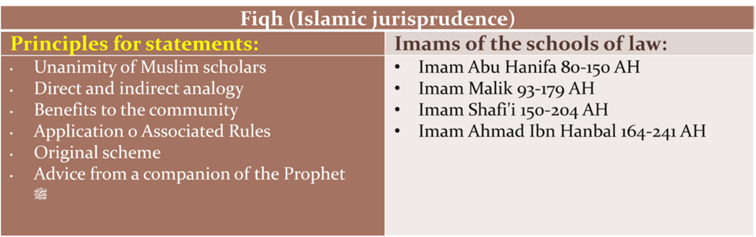
Table 1 Categorization fiqh
Information and the Quality of Modern Science in the Light of the Sharīʿah
Definition of Information
Information is the message issued by a sender and received by another party. This transfer of information can occur in various forms:
- Verbal transmission: written or oral words.
- Non‑verbal transmission: images, sounds, body language, eye contact, tastes, smells, facial expressions, etc.
Information plays a crucial role in both formal communication (structured, purposeful exchanges such as appointments and agreements) and informal communication (unstructured exchanges, often gossip).
Quality of Information
For information to be valuable, it must meet recognized standards. Modern science and communication management—particularly in ICT environments—reflect principles already embedded in Islamic methodology.
Allāh Taʿālā reveals:
يٰأَيُّهَا ٱلَّذِينَ آمَنُواْ ٱجْتَنِبُواْ كَثِيراً مِّنَ ٱلظَّنِّ إِنَّ بَعْضَ ٱلظَّنِّ إِثْمٌ وَلاَ تَجَسَّسُواْ وَلاَ يَغْتَب بَّعْضُكُم بَعْضاً أَيُحِبُّ أَحَدُكُمْ أَن يَأْكُلَ لَحْمَ أَخِيهِ مَيْتاً فَكَرِهْتُمُوهُ وَٱتَّقُواْ ٱللَّهَ إِنَّ ٱللَّهَ تَوَّابٌ رَّحِيمٌ
“O believers! Avoid most suspicions, for some suspicion is a sin. Do not spy, nor backbite one another. Would any of you like to eat the flesh of his dead brother? You would abhor it. And fear Allāh; indeed, Allāh is Oft‑Returning, Merciful.” (Al‑Qur’ān, 49:12). This verse emphasizes the need to verify information before giving it value. Suspicion, gossip, and false reporting are condemned, while accuracy and truthfulness are upheld.
Classical Methodologies
Imām al‑Bukhārī (194–256 AH) applied a rigorous methodology in compiling Ṣaḥīḥ al‑Bukhārī, ensuring authenticity through strict verification of narrators and chains of transmission. Other prominent scholars, such as Imām Jalāl al‑Dīn al‑Suyūṭī (849–911 AH) and Imām Aḥmad Raza Khan al‑Qādrī (1272–1340 AH), also employed meticulous methods to preserve the integrity of Islamic knowledge.
Standards of Valuable Information
For information to be recognized as valuable, it must meet the following qualities:
- Availability: accessible when needed.
- Accuracy: free from error.
- Reliability: consistent and dependable.
- Authenticity: genuine and trustworthy.
- Verifiability: supported by evidence.
- Completeness: comprehensive and not partial.
If any of these qualities are absent, the message becomes imperfect and void. Decisions—whether legal, business, or personal—can only be sound when based on information that meets these standards.
Dalāʾil (Evidence) in Uṣūl al‑Fiqh
The dalāʾil (evidence) exist in two types:
- Extensive evidence (dalīl ijmālī): General principles that apply across fiqh, such as:
- al‑Amr li‑l‑wujūb – a command indicates obligation.
- an‑Nahy li‑t‑taḥrīm – a prohibition indicates prohibition.
These broad principles form part of uṣūl al‑fiqh.
- Detailed evidence (dalīl tafṣīlī): Specific arguments and proofs applied to individual rulings. Only after examining detailed evidence can aḥkām (legal rulings) be applied.
Thus, aḥkām require both detailed proofs and extensive principles. This demonstrates the necessity of uṣūl al‑fiqh for understanding fiqh itself, as it provides the basis for deriving rulings and exercising ijtihād (independent reasoning).
The Aḥkām (Legal Rulings) of Fiqh
Fiqh is based on five categories of aḥkām:
- Wājib (obligatory): Actions rewarded if performed, punished if neglected.
- Ḥarām (prohibited): The opposite of obligation; actions punished if performed.
- Masnūn / Mandūb (recommended): Actions rewarded if performed, but no punishment if omitted.
- Makrūh (discouraged): The opposite of recommendation; actions disliked but not punished.
- Mubāḥ (permissible): Actions neutral; neither rewarded nor punished.
Subcategories of Wājib
- Fard ʿayn (individual obligation): Obligations required of every morally responsible (mukallaf), adult (bāligh), and sane (ʿāqil) person. Most Sharīʿah rulings fall into this category (e.g., daily prayers).
- Farḍ Kifāyah (collective obligation): Duties required of the community, but not every individual (e.g., learning beneficial sciences, calling the adhān, enjoining good and forbidding evil).
Principles of Sharʿī Rulings
The term Sharʿī means “legal” or “according to Sharīʿah.” It indicates whether something is religiously permissible, valid, or correct according to Islamic standards.
- If an action brings clear benefit (maṣlaḥah), it may be obligatory or recommended.
- If an action brings clear harm (mafsadah), it may be prohibited or disliked.
Examples:
- A Sharʿī nikāḥ is a marriage that fulfills Islamic conditions.
- A Sharʿī ḥukm refers to a ruling based on the Qur’ān and Sunnah.
Types of Ḥukm Sharʿī
Islamic jurisprudence divides al‑ḥukm al‑Sharʿī (divine judgment) into two main types:
- Ḥukm Taklīfī (obligatory rulings): Regulations indicating what is obligatory (wājib), recommended (mandūb), permissible (mubāḥ), discouraged (makrūh), or forbidden (ḥarām).
- Ḥukm Waḍʿī (conditional rulings): Provisions describing conditions, causes, or impediments that affect the application of ḥukm Taklīfī.
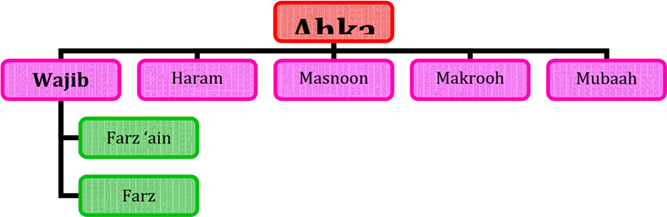
Exhibit 2 Categorization Aḥkām
Sharʿī Rulings and Legal Maxims
If something is Sharʿī, it means that it is in line with the divine guidelines revealed in Islamic sources. Matters authorized and approved by the Lawgiver (al‑Shāriʿ) may lead to good and thus be integrated into what is permitted, but at other times they may lead to evil and thus be joined to what is prohibited. This principle is expressed in the maxim: “al‑wasāʾil lahā aḥkām al‑maqāṣid” (Means take on the same ruling as their objectives.). This maxim teaches that the legal status of a means (wasīlah)—whether obligatory, recommended, permissible, disliked, or forbidden—depends on the ruling of the intended goal (maqṣad).
Examples
- If ḥajj (pilgrimage) is obligatory for someone, then booking travel and obtaining a visa—though not acts of worship themselves—take on the same obligatory ruling.
- If stealing is forbidden, then planning or facilitating the theft is also forbidden, even if those actions are not theft per se.
This maxim is rooted in the broader field of Maqāṣid al‑Sharīʿah (objectives of Islamic law), which emphasizes the spirit and purpose behind legal rulings.
Foundational Principle
From this, we learn the maxim: “mā lā yatimmu al‑wājib illā bihi fa‑Huwa wājib”
(What is needed to fulfill an obligation is itself an obligation.)
This is a foundational principle in uṣūl al‑fiqh. Similarly:
- What is needed to perform a recommended act (masnūn) becomes recommended.
- What leads to a forbidden act (ḥarām) is prohibited.
- What leads to a disliked act (makrūh) is itself disliked.
Adillah (Sources of Fiqh)
The adillah (evidence) for fiqh are obtained from four primary sources:
- The Holy Qur’ān and Sunnah – These are the foundational sources upon which the mukallafūn (morally responsible individuals) are addressed and upon which the religion is built.
- Ijmāʿ (consensus) – Agreement of qualified scholars on a ruling, derived from the Qur’ān and Sunnah.
- Qiyās al‑Ṣaḥīḥ (sound analogy) – Extending rulings from established texts to new cases based on shared reasoning, also derived from the Qur’ān and Sunnah.
Thus, fiqh does not bypass these four uṣūl (foundations); rather, it is firmly based upon them.
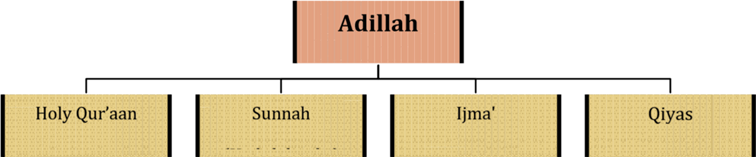
Exhibit 3 Categorization Adillah
Aḥkām and Adillah in Uṣūl al‑Fiqh
The majority of important aḥkām (legal rulings) are derived from the four adillah (evidence): the nuṣūṣ (texts) of the Holy Qur’ān and the Sunnah, ijmāʿ (consensus), and qiyās al‑ṣaḥīḥ (sound analogy). These sources provide guidance because they bring benefit (for example, in contracts) or prevent harm (for example, in prohibitions). Only in exceptional cases do scholars depart from these foundations; in such situations, reference is always made back to the four uṣūl as closest to the truth (Al‑Shāfiʿī, n.d.; Al‑Juwaynī, n.d.). Ijmāʿ relates to any matter of the Sharīʿah or any issue relevant to the Muslim community.
Types of Ijmāʿ
- Open ijmāʿ: Scholars (muftī, ʿālim) express their opinions publicly until consensus is reached. They may also be asked individually to give their opinion, which other scholars can then review.
- Silent ijmāʿ: A scholar issues a ruling and shares it with others, who neither explicitly support nor reject it.
In both ways, it is necessary that the scholars involved have a deep understanding of the matter. Once ijmāʿ is established, the ruling becomes binding (Abū Dāwūd, n.d.; Al‑Suyūṭī, n.d.).
Textual Foundations of Aḥkām
The aḥkām al‑Sharīʿah (legal rulings) are sometimes derived directly from a specific text of the Qur’ān or Sunnah. This can take different forms:
- Nuṣūṣ (clear text): A text with a single, unambiguous meaning.
- Ẓāhir (apparent meaning): A text that indicates significance, either through wording or context.
- Manṭūq (explicit meaning): A ruling derived directly from the wording of the text.
- Mafhūm (implied meaning): A ruling inferred from the text, sometimes equal to or even stronger than the manṭūq.
In cases of divergence, the mafhūm may differ from the manṭūq, especially when the manṭūq is linked to a waṣf (attribute) or sharṭ (condition). If the attribute or condition is absent, the ruling may change (Al‑Ghazālī, n.d.; Ibn Kathīr, n.d.).
Sharīʿah and English & Dutch Courts
Shaykh Faizul Aqtāb Siddiqi, a highly educated Islamic scholar, Barrister at Law, and Chair of the Governing Council of the Muslim Arbitration Tribunal, identified gaps in British law and used this opportunity to benefit Muslims. The Muslim Arbitration Tribunal, founded in 2007, is a form of alternative dispute resolution operating under the Arbitration Act 1996. It is available in the United Kingdom to Muslims who wish to resolve disputes without recourse to the traditional court system. The tribunals operate in London, Bradford, Manchester, Birmingham, and Nuneaton. Their rulings can be enforced in both the County Courts and the High Court. Media outlets have described this as a system of Islamic Sharīʿah courts with the power to rule in civil cases. By 2008, the courts had dealt with approximately 100 cases, including matters of inheritance and disputes between neighbors (Siddiqi, 2007; Bowen, 2010).
Lord Phillips, Chief Justice of England and Wales, stated in his speech of 3 July 2008 at the East London Muslim Centre: “I propose to explain to you the ways in which the law has changed, with the result that Muslim men and Muslim women are entitled to be treated in exactly the same way as all other men and women in this country. And there is, of course, another side to this coin. Rights carry with them obligations, and those who come to live in this country and to benefit from the rights enjoyed by all who live here, also necessarily come under the same obligations that the law imposes on all who live here. The title of my talk is ‘equality before the law,’ and it may be helpful to consider at the outset what ‘the law’ is. The law that I am to talk about is the set of rules that govern how we live in society. They are rules made by those with authority to make them and rules that are enforced by those with authority to enforce them. (Phillips, 2008). He further stated: “Sir John Donaldson, one of my distinguished judicial predecessors, put it in this way: ‘The starting point of our domestic law is that every citizen has a right to do what he likes, unless restrained by the common law or by statute’.” (Phillips, 2008).
In the Netherlands, Justice Minister Piet Hein Donner remarked in 2006 that it should be possible for Muslim groups to come to power through democratic means. He emphasized that every citizen has the right to argue for changes in the law. Donner stated: “If two‑thirds of all Dutch people would like to introduce the Sharīʿah tomorrow, then the possibility should exist. Something you can legally do is not to be stopped. It would be a shame to say, ‘That cannot be! The majority counts. That is exactly the essence of democracy.’” (Donner, 2006).
The Minister also emphasized that certain aspects of Sharīʿah conflict with the Dutch Constitution. Nevertheless, in the theoretical situation that a majority of the Dutch public wanted Sharīʿah, the Constitution would have to be altered (Donner, 2006).
Conclusion
Islam is a comprehensive way of life. It teaches systematic living with love, confidence, honesty, sincerity, surrender to the Will of Allāh, and obedience to Him and His Holy Prophet ﷺ (Al‑Qur’ān, 3:19; Al‑Qur’ān, 5:3). The quality of life, as referred to above, is defined by these unconditional values. Tools such as fiqh serve as instruments for an obedient life, carefully designed within Islam (Al‑Shāfiʿī, n.d.; Al‑Ghazālī, n.d.).
The possibility of Sharīʿah as law in Europe arises because there are many comparable aspects between Sharīʿah and Western legal traditions. Both systems emphasize justice, fairness, and the protection of rights, even though they differ in theological foundations (Phillips, 2008; Donner, 2006).