Table of Contents
- Summary
- Introduction
- Why should I bother?
- Purpose of our creation
- Personal benefits of being charitable (qualities it brings about)
- Is Servitude a Barrier to Material Ambition?
- Success at what cost?
- Becoming a Beacon of Humanity (Role Model)
- The Need for Humility (A Path to True Inner Contentment and Inspiring Change Around Us)
- Conclusion
Summary
The Way of Life chosen by Allāh for Muslims covers every aspect of their lives. It is the sum of directives, commandments, and instructions from the Highest Authority in the Universe: the Creator, the Sustainer, and the Master of the Day of Resurrection. His commands are final and cannot be abrogated, for there is no authority higher than Him. Together, these commands shape the character and conduct of Muslim members of an Islamic society.
Objectives of this part:
- Understanding of accidental society from the Islamic point of view
- Understanding of intentional society from the Islamic point of view
Introduction
Human beings have long been social creatures, living collective lives. A group of people living together is called a society. Society may be defined as a group of individuals whose lives are interconnected because they share common desires or interests, which they work together to realize. The formation of such a group may be accidental or intentional.
- Accidental society: A society, usually a small municipality or urban community, composed mostly of residents rather than commercial businesses or industrial facilities. These three types—residential, commercial, and industrial—are considered the main occupants of a typical community.
- Intentional society: A planned residential community designed to have a much higher degree of teamwork than other communities. Members of intentional communities typically share a common social, political, religious, or spiritual vision and are often part of an alternative society.
Reflection on one’s own culture is a distinctive feature of Western civilization. In the twentieth century, Western culture became reflexively problematic, with doubts about the sustainability of its core values. These doubts manifested as questioning the Western notion of rationality, which is therefore considered critical. Two alternatives exist: expanding the critique of norms and values and developing new conceptions of rationality. This must be done constructively and positively, so that thinking about culture from the perspective of philosophy of religion can be broadened.
Why Should I Bother?
Brigadier Gulzar Ahmed notes in his article that the Muslim calendar begins with the Hijrah (migration), which marks the construction of Islamic society (Ahmed, 1998, p. 14). To understand this, we must look back to the pre‑Hijrah Meccan period, during which the Prophet Muhammad ﷺ and his Companions endured harsh persecution at the hands of the Quraysh, the leading tribe of Mecca—even though the Prophet ﷺ himself belonged to a respected family of that tribe.
The Quraysh persecuted Muslims but did not allow them to leave Mecca, fearing that if they established themselves elsewhere, Islam would flourish and their numbers would grow, threatening Quraysh authority. They tried to bring back Muslims who had migrated to Abyssinia, but the Christian king refused to hand them over. Later, when the Hijrah to Medina began, the Quraysh attempted to prevent citizens from emigrating (Ibn Hishām, Sīrah, Vol. 1, pp. 321–325).
The Quraysh’s Plan
The Meccan leaders thought they could negotiate with the Prophet ﷺ through his uncle, Abū Ṭālib. A delegation angrily complained: “Your cousin disgraces our ancestors and our gods. Tell him to stop or leave him to his fate.”
Abū Ṭālib warned the Prophet ﷺ of the danger, but the Prophet ﷺ replied firmly:
“By Allāh, I will continue my mission. Even if all my family and friends abandon me, I will not stop revealing the truth. Even if death stares me in the face, I will not cease my mission.” (Al‑Ṭabarī, Tārīkh al‑Ṭabarī, Vol. 3, p. 45).
Struck by his honesty and resolve, Abū Ṭālib said: “Do as you see fit. Nobody will harm you as long as I live.”
The Quraysh’s plan failed. Intimidation and temptation had no effect. They then tried to make the Prophet’s life unbearable: slaves who converted were flogged mercilessly, dirt was thrown on him in the streets, thorns were placed in his path, and noise was made to drown out his preaching in the Kaʿbah (Ibn Kathīr, al‑Bidāyah wa’l‑Nihāyah, Vol. 3, p. 112).
The Hijrah
When the Quraysh conspired to kill him, the Prophet ﷺ received a message from Allāh to leave for Yathrib (Medina). He entrusted ʿAlī ibn Abī Ṭālib (raḍiyAllāhu ʿanhu) with returning people’s deposits and left his house at midnight while ʿAlī slept in his bed.
The Prophet ﷺ went to Abū Bakr’s (raḍiyAllāhu ʿanhu) house, and together they set out with two camels. About 8 kilometers from Mecca, they sought refuge in the cave of Thawr. The Quraysh offered a reward of 100 camels for capturing the Prophet ﷺ, and search parties scoured the valleys and hills.
When Abū Bakr grew anxious, the Prophet ﷺ reassured him: “Do not be afraid; certainly, Allāh is with us.” (Al‑Qur’ān, 9:40, Part 10, p. 187).
They remained hidden for three days and nights. On the fourth day, they continued their journey. Along the way, Suraqa ibn Juʿsham, a Meccan warrior, pursued them. His horse stumbled three times, and he realized he was confronting divine power. Seized with fear, he asked forgiveness, which the Prophet ﷺ granted immediately (Muslim, Ṣaḥīḥ Muslim, Vol. 4, p. 201).
Yathrib, the City of the Prophet ﷺ
After a journey of six days from Mecca, the refugees arrived at Qubā, a village five kilometers from Yathrib. The Messenger of Allāh ﷺ stayed there for two weeks. In the meantime, ʿAlī (raḍiyAllāhu ʿanhu) arrived. The first mosque of Islam, the Qubā Mosque, was built here, with the Prophet ﷺ and his Companions working hard in its construction.
During this time, the people of Yathrib eagerly awaited the Prophet’s arrival. Each morning, they went out of the city, looking toward Qubā for signs of his coming. On a Friday morning, the Prophet ﷺ left Qubā. A lively reception awaited him in Yathrib: women and children lined the streets, and women sang cheerful songs from the rooftops.
The Prophet ﷺ rode into the town on his camel. Everyone wanted him as their guest, but he said: “I will be the guest of the person at whose house the camel stops.” The camel stopped at the house of Hazrat Abū Ayyūb al‑Anṣārī (raḍiyAllāhu ʿanhu), who was honored to host the Messenger of Allāh ﷺ for seven months until the Prophet’s own house was built.
From that moment, Yathrib was renamed Madinat‑un‑Nabī (City of the Prophet), later known simply as Medina. Once a farming community, it became the center of a revolution that changed the course of humanity.
Establishment of Society
The establishment of Muslim society in Medina proceeded gradually, with its authority based on the revealed Word of Allāh—the Qur’ān—and the Prophet’s ﷺ instructions, preserved in the Ahādīth. His actions and way of life (Seerah) were based on the Qur’ān. The formation of Muslim society took place throughout his stay in Medina and culminated with Divine Words.
Allāh reveals:
يٰأَيُّهَا ٱلنَّاسُ إِنَّا خَلَقْنَاكُم مِّن ذَكَرٍ وَأُنْثَىٰ وَجَعَلْنَاكُمْ شُعُوباً وَقَبَآئِلَ لِتَعَارَفُوۤاْ إِنَّ أَكْرَمَكُمْ عَندَ ٱللَّهِ أَتْقَاكُمْ إِنَّ ٱللَّهَ عَلِيمٌ خَبِيرٌ
“O people! We created you from one man and one woman and made you into nations and tribes so that you may recognize one another. Indeed, the most honored among you in the sight of Allāh is the most pious. Verily, Allāh is Knowing, Aware.” (Al‑Qur’ān, 49:13, Part 26, p. 512).
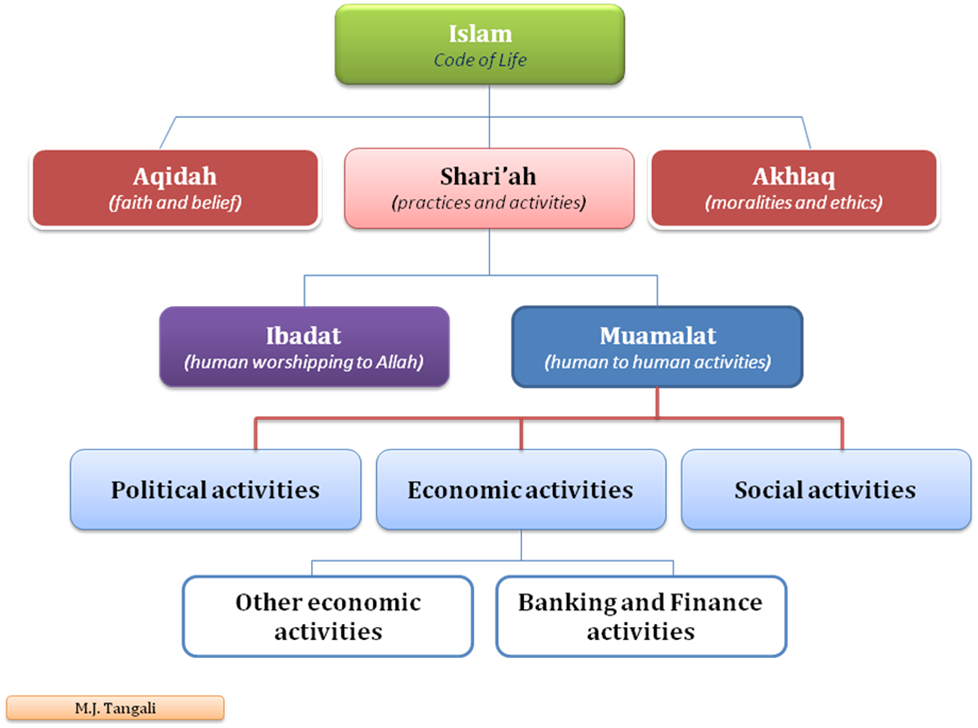
The Way of Life chosen by Allāh for Muslims covers every aspect of their lives. It is the sum of directives, commandments, and instructions from the Highest Authority in the Universe—the Creator, the Sustainer, and the Master of the Day of Resurrection. His commands are final and cannot be abrogated, for there is no authority higher than Him.
Allāh reveals:
وَكَأَيِّن مِّن قَرْيَةٍ هِيَ أَشَدُّ قُوَّةً مِّن قَرْيَتِكَ ٱلَّتِيۤ أَخْرَجَتْكَ أَهْلَكْنَاهُمْ فَلاَ نَاصِرَ لَهُمْ
“And how many a city, stronger in might than the city which expelled you, have We destroyed, and they had no helper.” (Al‑Qur’ān, 47:13, Part 26, p. 498).
Scope of the Commands
These commands cover:
- The behavior of individual Muslims with one another and with society.
- Relations with others, including promises, treaties, and transactions.
- Family affairs, including treatment of parents by children and relations between spouses.
They are obeyed because they emanate from the Highest Authority, the Creator of humankind—to whom all are answerable. The system operates on the Īmān (faith) of individual members and their Ahl al‑Amr (men with authority) in Muslim societies across the globe.
Purpose of Our Creation
Man is a social being. There can be no doubt that the conditions of his life depend on the conditions of the society in which he lives.
According to one view, the main factor in molding the life of every person is the individual himself, not society. Society is nothing but a collection of individuals who have learned by experience that their desires are better fulfilled when they cooperate with one another. As a result of this experience, they are attracted to collective life. Their incentive to lead a collective life is the fulfillment of personal desires. To safeguard their own interests, individuals have devised social systems. Thus, everywhere the hand of the individual is uppermost, and it is his desire and action that plays the basic role.
The corruption of society originates from the corruption of individuals. If every individual reforms himself, the whole society will automatically be reformed (Durkheim, The Division of Labour in Society, 1893/1997, p. 45).
Personal Benefits of Being Charitable
In certain forms of social gatherings, the members of the group do not choose each other. That is why they do not consider it necessary to have any previous acquaintance with one another to be part of that group. For example, a passenger on a bus, train, airplane, or ship does not feel the need to inquire about the moral character of other passengers, their views, or their motives for travel. Such inquiries are not even possible. Passengers are interested only in using a particular means of transport to go from one place to another, and no deep acquaintance is required to achieve this end.
According to another view, the truth is diametrically opposite to the individualist perspective. The exponents of this view hold that society and the social man are the material reality in this world, not the individual independent of others. What we find on earth is only a collection of men mutually correlated, and that is what society is.
Just as in the natural world every being is subservient to a universal system of nature and is not independent, similarly in society an individual is only a part of it, governed by its overall system. Even the ideas of an individual—his way of thinking, desires, aspirations, and will—are reflections of his natural and social environment and the economic conditions of his society and class (Weber, The Sociology of Religion, 1922/1964, p. 88).
Is Servitude a Barrier to Material Ambition?
According to this view, it is the mixture of the individual and society that is important. The individual is a being who is neither fully independent nor fully dependent on society. He occupies an intermediate position.
There is no doubt that the overall educational, economic, and political system of society leaves its impression on the individual, his ideas and personality. It evokes certain desires in him and suppresses others. It molds his life and guides his will. Nevertheless, its impact is not so strong as to make the individual completely subservient to his social environment.
It is like the impact of the natural environment. Unlike other beings, man is not entirely subservient to nature. In many cases, he rules over it, using his self‑consciousness and harnessing his latent inner forces to change or control his environment. He stands in the same relation to his social and class environment. He does not completely submit to it. Instead, he tries to understand sociological laws and, with the help of knowledge and hidden powers, seeks to control and change his social environment to his own advantage. He is not always reconciled with the existing social system (Durkheim, The Division of Labour in Society, 1893/1997, p. 112).
A part of the laws and social provisions relates to one’s behavior towards relatives, neighbors, colleagues, and co‑religionists. Human beings are naturally inclined to show love and tenderness to them. A social system whose rules align with this natural tendency can, by promoting and strengthening these sentiments, create an inner force to implement its provisions not only in this field but in all other fields of social behavior. All social rules are directly or indirectly related to the human feeling of observing the rights of others (Weber, Economy, and Society, 1922/1978, Vol. 1, p. 215).
As pointed out earlier, due emphasis is laid on the promotion and strengthening of pure and natural human sentiments in the social system of Islam. Several devotional acts—such as charity (sadaqāh), fasting (ṣawm), and pilgrimage (ḥajj)—strengthen communal and ideological collaboration (Al‑Qur’ān, 2:183, Part 2, p. 34).
Success at What Cost?
That is why the Qur’ān instructs everyone to find and tread the path of righteousness, and not to use the corruption of the environment as an excuse for personal deviation.
Allāh reveals:
إِنَّ ٱلَّذِينَ تَوَفَّاهُمُ ٱلْمَلاۤئِكَةُ ظَالِمِيۤ أَنْفُسِهِمْ قَالُواْ فِيمَ كُنتُمْ قَالُواْ كُنَّا مُسْتَضْعَفِينَ فِي ٱلأَرْضِ قَالْوۤاْ أَلَمْ تَكُنْ أَرْضُ ٱللَّهِ وَاسِعَةً فَتُهَاجِرُواْ فِيهَا فَأُوْلَـٰئِكَ مَأْوَاهُمْ جَهَنَّمُ وَسَآءَتْ مَصِيراً
“Those whose souls are taken by the angels while they were wronging themselves, the angels will say: ‘What were you doing?’ They will reply: ‘We were weak in the land.’ The angels will say: ‘Was not Allāhs earth spacious enough for you to emigrate therein?’ Such people will have Hell as their abode, and what an evil destination it is.” (Al‑Qur’ān, 4:97, Part 5, p. 92).
Social Systems and Balance
In every society, especially an intentional society, there exists a system that determines:
- The general customs and ways of life.
- The method of administration.
- Mutual relations among members.
- The relation of each member to the whole society.
- The rights and obligations arising from these relations.
For example, in a trading or industrial concern, it is necessary from the very beginning to define:
- Its aim and method of realization.
- The way of administration.
- The responsibilities of each functionary.
- The rights and powers of shareholders and office‑bearers.
- The rules governing the general body.
Only when these are established can the organization function properly.
The Analogy of the Human Body
Just as only a healthy and balanced body can grow properly, any defect in its systems causes disturbance and weakness.
- If body temperature rises above normal, fever and crisis result.
- If it falls below normal, weakness and imbalance ensue.
- Excessive increase or decrease in blood pressure, red or white blood cells, or vitamins lead to disease.
One must combat these imbalances to restore equilibrium, or else face decay and death.
This principle applies equally to human and spiritual matters. Too much or too little satisfaction of human desires is injurious to humanity. Balance is essential for both material and spiritual success (Ibn Kathīr, Tafsīr Ibn Kathīr, Vol. 2, p. 145).
Becoming a Beacon of Humanity (Role Model)
The term role model refers to a person who serves as an example, whose behavior is emulated by others. True role models are those who possess qualities we aspire to and who inspire us to become better people. They advocate for their goals, represent themselves with integrity, and take leadership on issues they believe in.
A nation that has no intention of attacking or betraying the Muslim Ummah or a Muslim country, and is not hostile against them, cannot be considered an aggressor. If such a nation enters a peace treaty or a pact of non‑aggression—respecting borders and rights mutually—this agreement must be honored. Whether concluded directly between Muslims and non‑Muslims, or as part of a broader covenant of mutual respect, such treaties remain binding if they are not violated through trickery or aggression. If a nation is found to be conspiring against Muslims, it will naturally be regarded as an enemy (Al‑Qur’ān, 8:61, Part 9, p. 165).
Historical Example: The Treaty of Ḥudaybiyyah
History shows that wherever the interests of the Muslim Ummah demanded, the Prophet Muhammad ﷺ concluded treaties of peace and non‑aggression—even with polytheists.
In the sixth year after Hijrah, he signed the Treaty of Ḥudaybiyyah with the Quraysh of Mecca. The Prophet ﷺ respected it and scrupulously implemented every clause until the Quraysh themselves violated it. Only then did the Prophet ﷺ act against them for breaking the treaty. This paved the way for the conquest of Mecca in the eighth year after Hijrah (Ibn Hishām, Sīrah, Vol. 2, pp. 315–320; Al‑Ṭabarī, Tārīkh al‑Ṭabarī, Vol. 3, pp. 90–95).
During his time in Medina, the Prophet ﷺ concluded several treaties and pacts, demonstrating his commitment to peace, justice, and the preservation of human dignity (Ibn Kathīr, al‑Bidāyah wa’l‑Nihāyah, Vol. 4, p. 45).
The Need for Humility (A Path to True Inner Contentment and Inspiring Change Around Us)
Mr. Kofi Annan stated in a lecture: “If Ibn Khaldun were alive today, I am sure this would be his message to the Muslim peoples: ‘Live up to the best traditions of your past and play your full part in a future of co‑existence and constant interaction between different traditions.’” (Annan, 2002, p. 14).
Humility is thus not only a personal virtue but also a collective necessity. It enables Muslims to draw from their rich intellectual and spiritual heritage while engaging constructively with other civilizations. Ibn Khaldun’s philosophy of history emphasized the cyclical rise and fall of societies, and humility is a safeguard against arrogance and decline.
Conclusion
Prophet Muhammad ﷺ undertook the formation of Islamic society based on the Qur’ānic commandments of Allāh after his migration to Medina. The events of his life gain their full significance only when viewed in the light of the law revealed during the Medina period.
Sharīʿah, apart from the fundamental belief in One Allāh, was primarily developed in Medina. This enhances the importance of the Hijrah in the Sīrah (life history) of the Prophet ﷺ. As the Last Prophet, he sealed the Code of Guidance for humanity for the entirety of their existence on earth.
If asked what the criteria of an Islamic society are, the answer is clear: unless a society in its communal life follows the pattern set by the Sīrah of the Prophet ﷺ during his life in Medina, it does not qualify to be called a Muslim society.
It was this society, created by the Prophet ﷺ in Medina, which bore the burden of a long, drawn‑out struggle against heavy odds. The people of Medina, despite their limited numbers and lack of weapons, rose to the occasion and accepted the challenge to confront the Quraysh of Mecca. Their resilience and faith ensured the survival and flourishing of the Islamic community (Ibn Hishām, Sīrah, Vol. 2, pp. 315–320; Al‑Ṭabarī, Tārīkh al‑Ṭabarī, Vol. 3, pp. 90–95).